List of United Bank for Africa Sort Codes (2026)
United Bank for Africa Sort Codes: What They Are and How To Use Them
Every payment instruction that leaves or enters a bank account carries a few small numbers that decide where the money lands. Among them, the sort code is the one people most often guess at, copy wrongly or confuse with something else. When it is wrong, a transfer can be delayed, returned or sent through a longer route than necessary. This guide explains United Bank for Africa sort codes in plain language, shows the codes you will meet most often, and tells you exactly where to find the one that belongs to your account.
What a Sort Code Actually Is
A sort code is a numeric identifier that points to a bank, and in many cases to a specific branch of that bank. Think of it as the street address of the place where your account is held. The account number tells the system which account to credit; the sort code tells it which institution, and sometimes which branch, to send the instruction to first.
In Nigeria the picture is slightly more layered than in some other countries, because several different codes sit side by side. Cheque clearing, electronic transfers, card networks and international payments each lean on a different identifier. Once you can tell these apart, the confusion disappears.
The Main Codes For United Bank for Africa
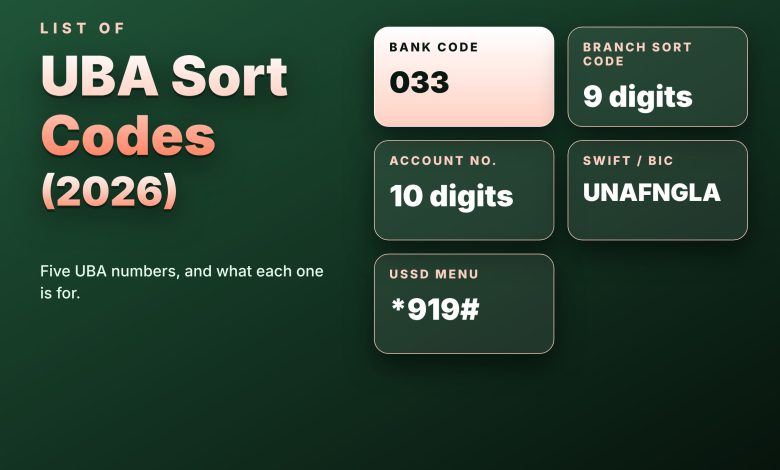
These are the identifiers people usually mean when they search for United Bank for Africa sort codes:
Notice that none of these replaces your account number. They sit beside it. A complete payment instruction needs the account number, the account name, the bank, and whichever of the above codes the form asks for.
Why Branch Sort Codes Differ
United Bank for Africa runs a very large branch network, and a branch-level sort code identifies the exact location where an account was opened. Two accounts at different branches can therefore share the same bank code of 033 yet carry different full sort codes. This is normal, and it is the reason a single published number can never be the right answer for every account holder.
For most day-to-day activity, the branch detail is invisible. Mobile transfers, USSD payments and card purchases route automatically. The full branch sort code only matters in a handful of situations, which brings us to the next point.
When You Will Need a Sort Code
- Cheque deposits and clearing. Cheques carry the code printed along the bottom edge, and it guides the clearing process.
- Standing orders and direct debits. Setting up a recurring payment with an institution usually asks for the sort code of the account that will pay or receive.
- Payroll and bulk payments. Finance teams uploading salary or supplier files commonly fill a column for the bank code or sort code.
- International transfers. Foreign senders often ask for the sort code alongside the SWIFT code, even though the SWIFT code does most of the routing.
- Official forms. Tax, pension and registration forms sometimes request full banking details, including the code.
- Account verification. Some platforms check that the bank code and account number belong together before approving a payout.
Where To Find Your Own Sort Code
Since the branch code depends on where your account lives, the most reliable source is always something tied to your own account. These are the places to look, in order of convenience:
If a form only asks for the bank code, enter 033. If it asks for the institution code used for instant transfers, enter 000004. If it asks for the branch sort code, take it from your own documents rather than guessing.
Sort Code, Bank Code and SWIFT Code Compared
Much of the trouble people have comes from using one in the place of another. Here is the difference in a few lines:
- Sort code: identifies the bank and often the branch; used for cheques, bulk files and some recurring payments.
- Bank code (033): identifies the institution only; the shortest of the set and the base of many longer codes.
- Institution code (000004): the six-digit identifier used by instant inter-bank transfer systems.
- SWIFT code (UNAFNGLA): the international network identifier for cross-border payments.
When a payment form lists one field and you have a different code in hand, stop and check the label. Entering the right number in the wrong field is as bad as entering the wrong number.
How To Use the Code in a Transfer
For ordinary app and USSD transfers you will rarely type a sort code at all, because the system fills in the routing for you. The steps above apply when a form or a corporate platform asks for it explicitly.
Mistakes That Delay Payments
- Copying a code from an unverified list instead of from your own statement or cheque book.
- Typing the SWIFT code where a local code is required, or the other way round.
- Dropping the leading zeros. Codes such as 000004 and 033 start with zeros that must stay.
- Adding spaces or dashes in a field that accepts digits only.
- Using an old branch code after an account has been moved to another branch.
- Skipping the account name check and sending money before the name appears.
6 Habits That Keep Your Banking Details Clean
- Save your complete banking details in one private note, with the codes labelled by type.
- Store the bank code, institution code and SWIFT code separately so they are never mixed up.
- Confirm the branch code again whenever your account is transferred to another branch.
- Print a stamped confirmation letter if an organisation needs proof for a long-term arrangement.
- Always read the field label before typing a number into it.
- Test a new recurring arrangement with a small amount first.
Frequently Asked Questions
Is the sort code the same as the account number? No. The account number identifies you; the sort code identifies the bank and often the branch.
Do I need a sort code for a normal mobile transfer? Usually not. The app routes the payment on its own once you choose the bank and enter the account number.
Does every branch have the same code? The bank code of 033 is shared, but the full branch sort code differs from one location to another.
What if a form rejects my code? Re-check the field label, remove any spaces and confirm that you are not using an old branch code.
Is the SWIFT code a sort code? No. It is the international identifier, used for cross-border payments only.
The Bottom Line
United Bank for Africa sort codes are simple once you separate the layers: 033 for the bank, 000004 for instant transfer systems, UNAFNGLA for international payments, and a branch code that lives on your own cheque book, statement and account screen. Match the right code to the right field, verify the account name before you send, and your payments will move the way they are meant to.