OPAY HOLDING LIMITED Swift/BIC codes in Nigeria (2026)
OPAY HOLDING LIMITED Swift/BIC codes in Nigeria (2026): The Exact Codes and How to Use Them
OPAY HOLDING LIMITED has two BIC entries on record: OPAHGB22 and OPAHGB32XXX. Both start with OPAH, the institution code, and both carry GB in the fifth and sixth positions, the country code for Great Britain. Neither carries NG. That one detail clears up most of the confusion around these codes, and the rest of this guide builds on it.
A BIC, also called a Swift code, is the address a bank uses on the international messaging network. It tells the network which institution, in which country and city, should receive a payment instruction. It does not describe an app, a phone number or a Nigerian bank account. Treating it as any of those is the root of most failed transfers.
Below you get the exact codes, what every character means, how the two entries differ, and what to do in Nigeria whether you are sending a local transfer, receiving money from abroad or filling a form that asks for a Swift code.
The short answer
◆ 8-character BIC: OPAHGB22
◆ 11-character form: OPAHGB22XXX
◆ Second entry: OPAHGB32XXX, whose 8-character form is OPAHGB32
◆ Country letters on both: GB, Great Britain
◆ Registered city: St Albans
◆ Nigeria-coded (NG) entry under this name: none found
Why a Nigerian payment brand carries a GB code
OPay is the name Nigerians know, but the records place OPAY HOLDING LIMITED at 4 Victoria Square, ground floor, St Albans, in the United Kingdom. A BIC takes its country letters from the country where the institution is registered. So GB is correct and expected for this entity, and it says nothing about where the wallet is used.
Everyday money movement inside Nigeria runs on the local interbank system, which has its own institution codes and never asks for a BIC. The Swift network only enters the picture when money crosses a border.
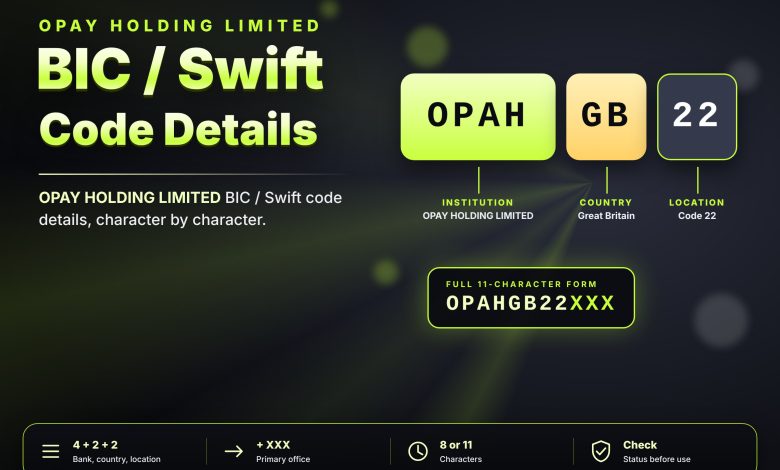
OPAHGB22, character by character
Institution code: 4 letters taken from the name OPAY HOLDING
Country: Great Britain
Location code: 2 characters
Branch code: optional, XXX means primary office
The first four letters identify the institution. The next two are the ISO country code. The next two, a letter or a digit each, mark the location. The final three are optional and point to a branch. When they are missing or read XXX, the code points to the primary office, so OPAHGB22 and OPAHGB22XXX point to the same place.
OPAHGB32XXX, the second entry
The second entry keeps OPAH and GB but changes the location code from 22 to 32, and it is written in the 11-character form OPAHGB32XXX. It sits at the same St Albans address. Records do not say why two entries exist under one name. A location code can change when an institution is re-registered or reorganised, so the two entries may belong to different periods or different purposes.
What matters for you: the two are not interchangeable. One changed digit sends a message to a different destination, so you never swap one for the other on a guess.
All the details in one table
| Field | Value |
|---|---|
| Legal name | OPAY HOLDING LIMITED |
| First entry, 8 characters | OPAHGB22 |
| First entry, 11 characters | OPAHGB22XXX |
| Second entry, 8 characters | OPAHGB32 |
| Second entry, 11 characters | OPAHGB32XXX |
| Institution code | OPAH |
| Country code | GB, Great Britain |
| Location codes | 22 and 32 |
| Branch code | XXX, primary office |
| City | St Albans |
Eight characters or eleven?
Banks accept both forms for a primary office. If the form gives you eight boxes, type OPAHGB22. If it gives you eleven, type OPAHGB22XXX. Never invent a branch code to fill space, and never add spaces or dashes, because the system reads the code as one unbroken string of capital letters and digits.
What a BIC does not do
◆ It is not an account number. A wire needs the beneficiary name, an account number or IBAN and the bank address along with the code.
◆ It is not a Nigerian bank code. For local interbank transfers, OPay uses the institution code 999992, which has nothing to do with Swift.
◆ It is not a UK sort code. Sort codes are six digits and apply to British domestic accounts, not to Nigerian wallets.
◆ It is not proof that an account exists. A valid-looking code only means the format is right.
Sending money to OPay from inside Nigeria
Choose OPay in the bank list, enter the 10-digit account number, which is the phone number without its leading zero, confirm the name that appears and send. No Swift code is involved. If any screen asks you for one on a naira transfer inside Nigeria, stop and check that you opened the right option.
Receiving money from abroad
The sender’s bank will ask for the beneficiary bank BIC, your account details and your address. The BIC they need is the one belonging to the institution that actually holds your account. We cannot confirm from outside that either OPAHGB22 or OPAHGB32XXX is active for a given wallet, and listings disagree on the status of these entries.
So the safe order is this: ask OPay support inside the app which receiving details apply to your account, get the answer in writing, copy those details exactly, and send a small test amount first. Only after the test lands do you send the full amount.
Why listings disagree about these codes
A Swift code can appear in several public directories, and each directory copies from a central register at a different time. One may show an entry without any status, another may mark the same entry as withdrawn, and a third may still list a retired location code. That is why a single screenshot proves nothing. The only source that settles the question for your payment is the institution that will receive it.
For OPAY HOLDING LIMITED the practical meaning is simple. The format of both codes is valid, the country is Great Britain, and the status is not something you should assume. Treat each listing as a lead, not as a confirmation.
How to read any BIC yourself
Once you can read one code, you can read them all. Count the characters first: eight or eleven. Look at characters five and six to find the country. Characters seven and eight give the location. Anything after that is a branch. Apply that to a code you receive from anyone and you will spot a wrong country or a broken length in seconds.
Take OPAHGB22 again. Count eight characters, read GB at positions five and six, and you know without any lookup that the entry is British. A code that claims to be Nigerian must show NG in exactly those two positions. If it does not, the claim is false, no matter how official the page around it looks.
When a form asks you for a Swift code
Forms from employers, freelance platforms, scholarship offices and foreign suppliers usually ask for the Swift code of the bank that holds your account. They want your bank, not the holding company of a payment brand. Read the label carefully: if it says beneficiary bank, give the details confirmed for your account. If it says intermediary bank, leave it empty unless the sender tells you to fill it.
If you cannot get a written confirmation before the deadline, say so to the sender and ask for a short extension. A delay of two days costs far less than a transfer that bounces and returns with deductions.
Mistakes that cost time and money
◆ Reading GB as if it meant a Nigerian entry. NG would be the Nigerian letters, and they are absent here.
◆ Swapping 22 and 32 because the two codes look alike.
◆ Using a Swift code for a local transfer that never needed one.
◆ Typing the code in lowercase or with spaces, which many forms reject.
◆ Sending a large amount before testing with a small one.
◆ Copying a code from an old screenshot instead of from a current written confirmation.
Five checks before you pay
◆ Length is 8 or 11 characters, no spaces.
◆ Characters five and six match the country of the bank.
◆ Location digits match the entry you were given, 22 or 32.
◆ The code came from a written reply tied to your account.
◆ A small test transfer arrived before the full amount goes out.
Quick questions
Is OPAHGB22 the Swift code of OPay in Nigeria?
No. It belongs to OPAY HOLDING LIMITED and carries Great Britain as its country.
Is there an NG entry under this name?
None was found, so any code claiming to be one deserves suspicion.
Do I need the code for a local transfer?
No. Local transfers use the account number and the bank list.
Which one do I use, 22 or 32?
Use the one you were given in writing for your own account. Do not choose by guess.
The two OPAY HOLDING LIMITED codes are OPAHGB22 and OPAHGB32XXX, both registered under Great Britain. Local Nigerian transfers never need them, and a cross-border payment should only go out on a code confirmed in writing for your account.